
Best Toys for Kittens at Each Age (and What to Skip)
LitterBond Team
By the LitterBond Team · Researched against Cornell Feline Health Center, iCatCare and VCA guidance · Last updated: November 8, 2026
The new kitten has been home for a week. She pounces on your toes under the blanket. She hunts dust bunnies under the couch. Then she falls asleep mid-step, in the gift bag you meant to use.
Here's the short answer. The best toys for kittens move like prey and fit small paws. Nothing on them should come off and get swallowed. The right toy also changes fast. A 10-week-old wants short chases. A teething 4-month-old mouths everything. By 8 months, she's ready for bigger kickers and longer games.
Below: what every kitten toy needs, what fits each age, and what to skip, starting with your hands. If she's a holiday kitten, or about to be one, this is your shopping list.
Five Checks for Any Kitten Toy
A good kitten toy acts like prey and has nothing that can come off. Kittens play like small hunters. They stalk, chase, pounce and grab. A toy that rolls, crinkles or flutters gives her something to hunt.
The UC Davis School of Veterinary Medicine suggests a mix. Its list includes ping-pong balls, soft stuffed animals, crinkly paper toys, feather toys and sticks she can't chew up.
The parts matter as much as the type. The Cornell Feline Health Center says to avoid toys with small pieces. It also warns about strand-like parts, such as feathers and string. They may come loose, especially when chewed, and get swallowed. So a feather toy is a play-together toy.
Before a new toy goes in the basket, run five checks:
✅ Five checks before a toy goes in her basket
- It moves: it rolls, crinkles, squeaks or flutters when she hits it
- It fits her: small and light enough to bat and carry
- Nothing comes off: no beads, bells or glued-on bits
- No string: no ribbon, yarn or wool either
- Feathers or cords? Then it's a play-together toy
Toys for 8 to 12 Weeks
At this age, play comes in short, wild bursts, and a wand toy is your best tool. Many kittens go home around now. Cats Protection says kittens shouldn't leave their mother until at least eight weeks, unless your vet says otherwise.
UC Davis says kittens have their most active play period from 7 to 14 weeks. They learn how hard to bite and scratch even earlier. A second UC Davis guide puts that window between 3 and 7 weeks, with help from mom and littermates. A kitten raised without them may not have that self-control yet. Toys give her a place to practice.
Good picks for now:
- A wand toy you move. International Cat Care (iCatCare) says wands with toy mice, feathers or worms may be especially attractive to kittens. Move it across the floor at different speeds.
- Ping-pong balls and crinkly paper. Both are on the UC Davis list. Roll a ball past her and watch her chase it.
- Small, soft stuffed toys. Pick ones light enough to bat and small enough to carry.
Keep games short. iCatCare says kitten play may last only a few minutes, because kittens get bored and tire easily. End the game slowly. Then turn her attention to something else, like a meal.
Catnip can wait. iCatCare says kittens don't respond before three months. Cat behavior consultant Pam Johnson-Bennett says many don't until closer to six.
Toys for 3 to 6 Months
This is teething season, so expect her to mouth almost everything. Her adult teeth are on the way. VCA Animal Hospitals calls chewing at this age natural.
You may notice her biting your hands more. VCA says not to let her get mouthy with your hands, even when it's cute. Its other tips are simple. Supervise her while she chews on toys. Skip anything very hard, like nylon. Throw out any toy that's breaking apart or missing pieces.
Talk to your vet about teething at her next visit. Ask what's fine for her to chew, too. Plush and fabric toys are for play, not for chewing.
Play gets bigger now, too. She grabs a toy with her front paws and kicks it with her back legs. Small toys she can grab, carry and kick fit this stage well.
LitterBond's squeaky catnip hedgehogs are one option. Each is palm-size, about 3.5 by 2.4 inches. They have a soft, shaggy back, a catnip pouch and a built-in squeaker. They come in assorted 3- and 6-packs, and the store picks the colors.
Know their limits. The squeaker is a small insert. The long pile can shed if she chews it. While she's teething, play together and put them away after every game. Throw a torn hedgehog away at once. Like any plush toy, they aren't made for chewing.

Cat toys
Small, soft and squeaky, for play together
Palm-size plush hedgehogs with a soft, shaggy back, a catnip pouch and a built-in squeaker. Assorted 3- or 6-packs; the store picks the colors. The squeaker is a small insert, so throw a torn hedgehog away, and put them away after play.
See the squeaky catnip hedgehogs →Catnip may not do much yet either. That's fine. Many kittens still play for the squeak, the texture or the chase.
Toys for 6 to 12 Months
By now she's bigger and stronger, and she's still very much a kitten. UC Davis says kitten-like play can last up to 2 years of age. It also gives a warning that fits this stage: "What might be cute at 10 weeks is painful at 10 months!"
Her toys can grow with her:
- Bigger kickers. A toy long enough to hug and bunny-kick gives her back legs a target.
- Toys to bat. She can whack a ball across the room now, then chase it down.
- Longer wand games. Let her stalk, chase and finally catch the toy.
For batting, LitterBond's catnip racket and ball sets pair a soft plush racket with a small ball. The ball has a feather plume she can swat. Feathers can be pulled out and swallowed, though. Keep this one for play together, and throw out a ball that loses its plume. Sets come assorted, and the store picks the mix. You get 3 Sets (6 pcs) or 6 Sets (12 pcs).
Catnip may start to matter around now. Not every cat reacts, even as an adult. If yours ignores it, here's why some cats don't react to catnip. The hedgehogs carry a catnip pouch too. If she starts to react, they may get a second look. If not, she still has the squeak.
Hands, Feet and Toys to Skip
Never let your hands or feet become her toys. iCatCare says it's tempting, and it seems cute at first. But as she grows, she links fingers and toes with playtime. That can turn into a serious problem. UC Davis says hands should only mean petting, comfort and good things.
So when she grabs your hand, give her a toy instead. UC Davis suggests a wad of paper or a wand toy. The Cornell Feline Health Center adds a tip. Keep the toy at a distance from your hands, so she can't bite or scratch you.
Never hit, swat at or scruff her. UC Davis warns that this may hurt her. Yelling is out too, since a young kitten will become fearful.
Then skip these toys:
🧶 String, ribbon and wool
iCatCare warns these can bunch up a kitten's intestines if eaten. That can mean emergency surgery. Pipe cleaner toys are on its list too.
🔩 Small, loose parts
Beads, bells and glued-on eyes can come off and be swallowed.
🪨 Very hard items
VCA says to avoid anything extremely hard, like nylon.
🪶 Feathers left out
Cornell warns that feathers can come loose and get swallowed.
✂️ Torn toys
A split seam or stuffing showing means the toy is done.
For the full rundown, see what to supervise and when to throw a toy out.
Solo Toys, Shared Toys and Rotation
A few toys can stay out, but most kitten toys come out only when you're there. Anything with feathers, cords, a squeaker or a rattle goes in a drawer after play. iCatCare gives the same advice for wand toys: put them out of reach when you're not playing.
For her time alone, keep it simple. Cornell says paper bags, cardboard boxes and ping-pong balls can be tremendously entertaining for cats. Check them now and then, and toss anything torn.
Rotation keeps old toys new. iCatCare suggests two or three toys on the go, rotated regularly, one at a time. Cornell says rotating toys can keep her from getting bored. Seal catnip toys in a bag or jar between sessions. Johnson-Bennett suggests tightly sealed containers when they're not in use.
Here's an easy swap routine:
-
1
Pick three toys
One to chase, one to bat and one to carry.
-
2
Bag the rest
Seal them in a bag or bin, catnip toys included, out of her reach.
-
3
Swap every few days
Bring out a "new" set and put the old one away.
-
4
Check as you swap
Throw away anything torn, frayed or missing a part.
A Kitten in a Home With a Cat
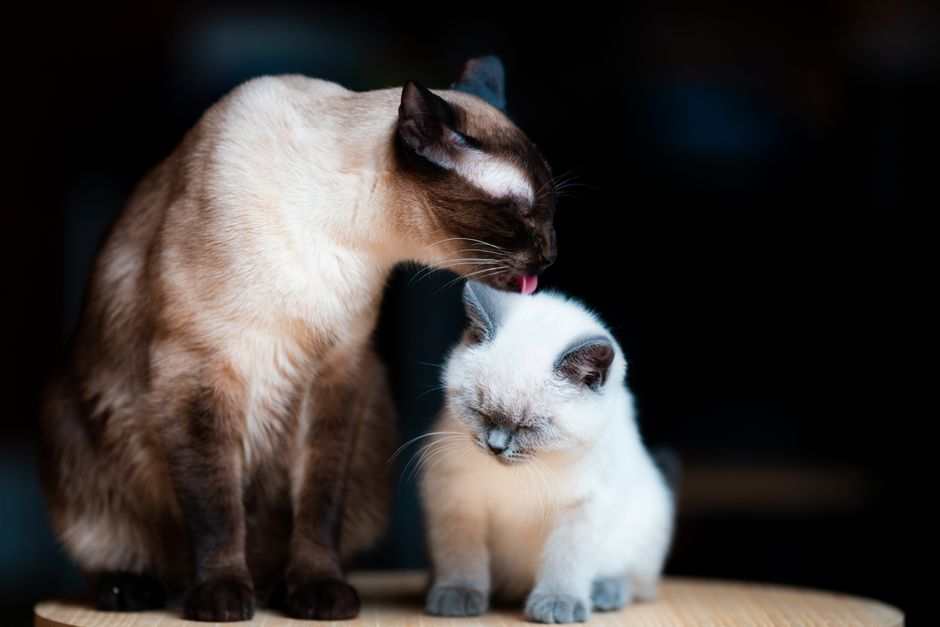
A kitten's energy can be a lot for an older cat, so give it somewhere else to go. Start with a slow, careful meeting. Here's how to introduce a new cat to your cat, step by step.
Rough play doesn't have to be your older cat's job. UC Davis lists one option: another kitten of similar size and temperament. If that's not in the plan, you can fill in. Short wand games with you each day give her a place to aim it all.
Give each cat their own toys, and play with the kitten on her own. Your older cat may still join in now and then. Let that be her choice.
A kitten who loses interest in play and food at the same time needs a vet check.
Tonight, set out three toys and bag the rest. Keep the feathered ones for play together. Put your hands away, and let the toy take the pounce. A month from now, she'll be bigger, and her toys can grow with her.
Questions this guide did not cover
Are laser pointers OK for kittens?
Only if the game ends with a catch. International Cat Care notes that a laser pointer lets a cat stalk, chase and pounce, but never catch. It suggests switching to a wand toy to finish the game, so it ends on a positive note.
Can a kitten use a puzzle feeder?
Yes, from about 12 weeks. International Cat Care says you can puzzle-feed kittens from as early as twelve weeks. It calls this a stimulating way for kittens to get their food. Start with an easy one, so she wins quickly.
What should I do if my kitten bites or scratches me?
Wash it well right away. UC Davis says cat scratches and bites should be washed thoroughly with soap and water. It adds that puncture wounds need medical care right away. Next time, have a toy ready to hand her.
When does a kitten become an adult cat?
Around her first birthday. The AAHA/AAFP Feline Life Stage Guidelines, as reported by the American Veterinary Medical Association, call a cat a kitten from birth up to 1 year old. From 1 to 6 years, she's a young adult.
Related reading
- Cat Toy Safety: What to Supervise and When to Throw It Out
- How to Introduce a New Cat to Your Cat: A Step-by-Step Plan
About this article
Researched and written by the LitterBond Team. Sources include the Cornell Feline Health Center, International Cat Care, VCA Animal Hospitals, the American Veterinary Medical Association (AVMA) and UC Davis School of Veterinary Medicine. Reviewed and updated November 8, 2026. LitterBond does not employ veterinarians; for medical decisions about your individual cat, always consult your veterinarian.


