
How Long Should You Play With Your Cat? A Simple Daily Play Plan
LitterBond Team
By the LitterBond Team · Researched against iCatCare and Cornell Feline Health Center guidance · Last updated: October 21, 2026
It's 9 p.m., and your cat is racing down the hallway again. You waved a toy at her after dinner. She batted it twice and walked off. Now she's on the counter, staring at you like you forgot something.
Here's the short answer. Most guides land on two or three short play sessions a day. Each one runs about 10 to 15 minutes. PetMD gives that range, and so does AAHA. But the shape of each session matters more than the minutes. International Cat Care (iCatCare) calls cats "sprinters rather than marathon runners." One minute of frenzied activity, it says, is a good result.
Below: the numbers by age, and one full session from stalk to nap. Then when to stop, and how to play with two cats.
How Long and How Often to Play
A few short sessions a day beat one long one. The American Animal Hospital Association (AAHA) says cats lose interest if a session runs too long. The Blue Cross adds that short daily sessions match how cats are naturally active.
So the honest answer is a range, not a rule. Start with two sessions a day of about 10 minutes. Then let your cat show you if she wants more or less.
Timing helps too. iCatCare notes that cats are often most active at dawn and dusk. AAHA calls mornings and evenings top picks for playtime. Try a game before breakfast and another before dinner. Then a meal can follow each one.
If winter keeps your cat inside more, play matters even more. iCatCare says cats who live only indoors need plenty of play to keep from getting bored.
How Age and Energy Change the Plan
Kittens want more, shorter games, and seniors want gentler ones. The numbers above fit a typical adult cat. Adjust them for yours.
🐾 Kittens
AAHA says kittens usually need several short sessions a day. iCatCare notes kitten play may last only a few minutes, since kittens get bored and tire easily. Cats Protection says younger cats will happily play 10 times a day or more.
🐈 Adult cats
AAHA says adults may thrive with one or two sessions a day. PetMD's two or three sessions fit here too.
🛋️ Senior cats
AAHA says older cats may still enjoy play, at a slower pace and for shorter times. iCatCare says to keep it gentle and suit her mobility. Cats Protection says older cats will love playing three or four times a day.
⚡ High-energy cats
PetMD notes that busy breeds like Bengals and Abyssinians need more play. Laid-back breeds like Persians and Ragdolls need less.
A senior doesn't have to sprint to get something out of it. iCatCare says even a cat who lies down to play still gains from one-to-one time with you.
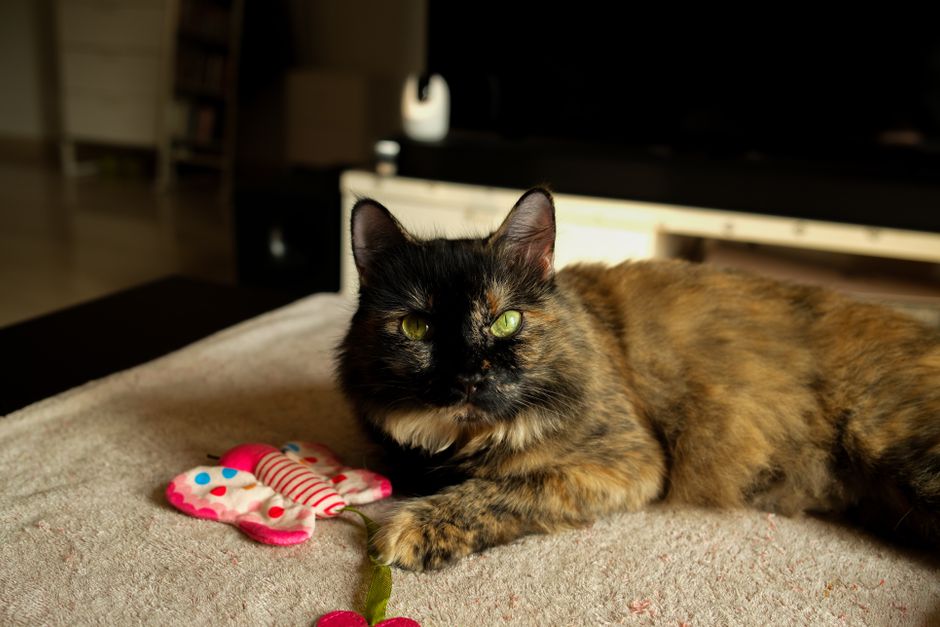
Your own cat's energy beats any chart. If she's still stalking your ankles after a session, add one more short game later. If she's done after two minutes, that counts.
How to Play With Your Cat
A good session copies a real hunt, from the first stare to the last bite. iCatCare lists the parts of a cat's hunt that play can cover: search, stalk, chase, pounce, catch and manipulate. Its guide to how cats hunt adds that short, frequent play sessions are closest to a cat's natural hunting pattern.
Before You Start
Grab a wand toy, the kind with a small toy on a string at the end of a rod. iCatCare notes that it keeps some distance between you and a kitten. That helps you avoid stray scratches and bites.
Never use your hands or feet as the toy. iCatCare warns that it can lead to serious problems as a kitten grows up and links fingers and toes with play. Have a small snack or her next meal ready before you begin.
The Hunt, Step by Step
-
1
Let her stalk
Move the toy away from her, the way prey would. Slide it along the floor and behind a chair leg. Let her crouch and watch.
-
2
Make her chase
Speed up and change direction. iCatCare suggests jerky, random moves.
-
3
Let her pounce
Pause the toy so she can land on it. Keep it low. The Blue Cross says not to lift wand toys so high that she jumps up.
-
4
Slow down and let her catch it
AAHA says to slow things down near the end and let her catch her "prey." Let her bite and kick it for a moment.
-
5
Feed her
AAHA suggests a snack at the end to complete the hunting sequence. The shelter Operation Kindness lists snacks, a meal or a small spoonful of wet food.
-
6
Let her groom and nap
Operation Kindness says cats then move on to grooming and, in time, a nap. Put the toys away and leave her be.
That's one full hunt. Two of these a day, about 10 minutes each, cover what most sources suggest.
Don't skip the catch. Cat Friendly Homes comes from the Feline Veterinary Medical Association. It says to let your cat capture the "prey" at the end of the hunt. The Blue Cross warns that a cat who never gets the catch may get frustrated or lose interest.
Toys for the Chase and the Catch
A wand toy can run the whole hunt. Many cats also love a toy they can run down and grab. iCatCare suggests toys as near to real prey as possible in size and texture.
For the chase, try a small toy you can toss. LitterBond's Squeaky Feather Tail Mice are shaggy plush mice with feather tails. They squeak when you shake them, so toss one and let her run it down. They come in assorted 3- or 6-Packs, with the colors picked by us. They have no catnip. The feathers, ears and nose loop are small parts, so play together and put them away after.
For the catch, give her something big enough to hug. Many cats grab a toy with their front legs and kick it with their back legs. That's the bunny kick, and here's why cats bunny kick. LitterBond's Catnip Snake Kickers are plush snakes about 17.7 inches long, with catnip inside. Drag one across the floor in slow curves, then let her grab it and kick. They come in assorted 3- or 6-Packs, with the patterns picked by us. The felt tongue is a small part, so play together and put them away after. Check it often. Retire any snake with a loose tongue, a split seam or stuffing showing.
Not every cat reacts to catnip. Young kittens often don't until around six months old. Many cats still play for the chase and the feel of the toy. Here's why some cats ignore catnip. To match toys to the way your cat plays, see what kind of toys cats like.
Using a laser pointer? End with a toy she can catch. iCatCare says a laser lets a cat stalk, chase and pounce, but not catch. Switch to a wand toy to finish, so the game ends on a positive note.

Play & enrichment
A mouse to toss for the chase
Shaggy plush mice with feather tails that squeak when you shake them. Toss one and let her run it down. No catnip. Assorted 3- or 6-Packs, colors picked by us. The feathers, ears and nose loop are small parts, so play together and put them away after.
See the Squeaky Feather Tail Mice →When to Stop and Let Her Rest
Stop when she walks away, or when she starts to pant. Cat Friendly Homes puts it plainly: when your cat walks away from you, she's done playing. Don't follow her with the toy.
End the game when you see any of these
- She walks away or turns her back on the toy.
- She pants or breathes with her mouth open.
- She quits chasing the toy and goes for your hands or ankles.
If she's still panting after a few minutes of rest, or pants after very little play, call your vet right away. PetMD says panting with pale, blue or gray gums, coughing or collapse needs emergency care. As the Cornell Feline Health Center puts it, any time there's a question about whether a cat can breathe comfortably, get her to a vet right away.
If play turns into attacks on you, end it. Maddie's Fund says to stop all play and calmly walk away when a cat starts attacking people. Try again later, with the wand toy between you.
A cat who loses interest in play and food at the same time needs a vet check.
How to Play With Two or More Cats
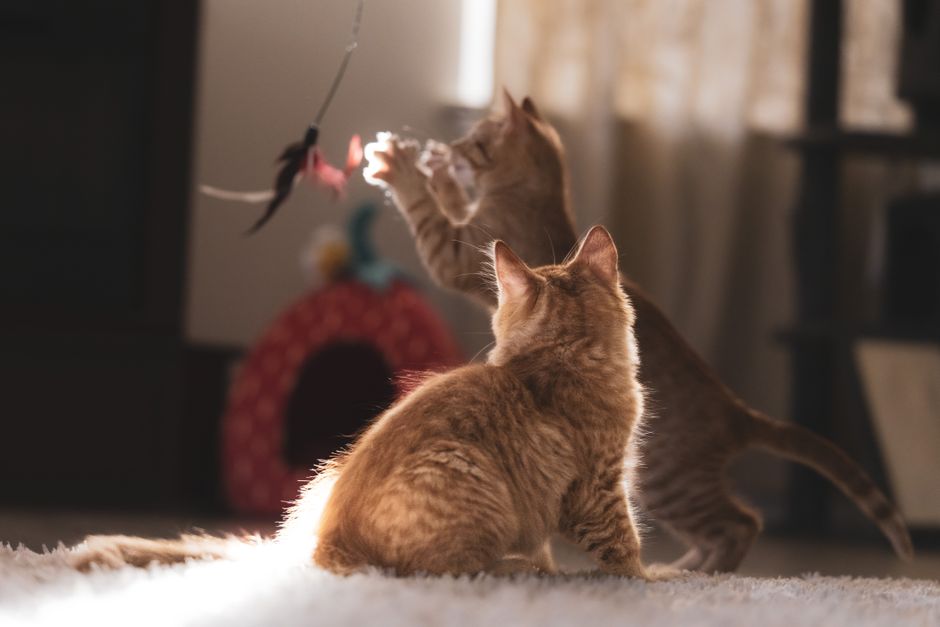
Give each cat her own hunt. Cat Friendly Homes says to play with each cat on her own. iCatCare explains why. In a home with several cats, one may want to play more than the others. It suggests setting aside time to play with each cat away from the group.
In real life, a bold cat can grab every catch while a shy one watches from the doorway. Try a different room for the shy cat, or play with her first. Each cat should get her own catch and her own snack.
How to Store and Rotate Toys
When the hunt ends, the hunting toys go away. Cat Friendly Homes warns that string, yarn and ribbon are easily swallowed. They can cause very serious gut problems that need surgery. So the wand toy goes into a closet or drawer after every session.
The same goes for toys with feathers or small parts. You can hang one of the feather tail mice from a door handle by its nose loop for a game. Do it only while you're home and watching, then take it down and put it away. Check every toy often, and throw away any that tear or have loose parts.
Keep the rest fresh by rotating them. iCatCare suggests two or three toys on the go, given one at a time. Cats Protection also says to swap toys around regularly. Seal the others in a bag and trade them in every few days.
If you do one thing tonight, play one short hunt before her dinner. Let her stalk, chase and pounce. Slow down and let her catch the toy, then serve her meal. Then watch what she does next. If she grooms and curls up for a nap, the hunt did its job. Do it again tomorrow morning, and you have a daily play plan.
Questions this guide did not cover
Why does my cat want to play so often?
Because a real hunt comes in many small bursts. International Cat Care says a cat with no food from a caregiver can make as many as 10 to 20 kills a day. Even a well-fed pet cat hunts for around three hours a day.
What can my cat do while I'm at work?
Let her hunt for her food. iCatCare says timed feeders or puzzle feeders can be used if you are out during the day, to keep meals small and frequent. Cats Protection adds a limit: don't leave her alone with toys she could shred and eat.
What if my cats play too rough with each other?
Step in if it escalates and one could get hurt. International Cat Care suggests distracting them with a wand toy, or a kick toy big enough to hold in the front legs and kick with the back legs. If fighting during play keeps happening, it says to ask your vet.
Related reading
- What Kind of Toys Do Cats Like? A Play Style Guide
- Why Does My Cat Bunny Kick? What It Means, What to Give Her
About this article
Researched and written by the LitterBond Team. Sources include International Cat Care, the Cornell Feline Health Center, PetMD, AAHA and Blue Cross. Reviewed and updated October 21, 2026. LitterBond does not employ veterinarians; for medical decisions about your individual cat, always consult your veterinarian.


