
Smell Cat Pee but Can't Find It? How to Track Down Hidden Spots
LitterBond Team
By the LitterBond Team · Researched against FelineVMA (AAFP), VCA and ASPCA guidance · Last updated: October 30, 2026
It's late October. The windows are shut, the heat is on, and the hallway smells like the litter box. You checked the box. You sniffed the couch and looked under the bed. There's no puddle and no stain.
The smell is real, even if you can't see the spot. Dried cat pee is hard to see. So you search low, one room at a time. You use a black light in a dark room and check each glow with your nose. Then you soak every spot you find as deep as it went.
One thing first. Has your cat started peeing outside the litter box? Call your vet before you start cleaning. A new spot can be a sign of a urinary problem. A male cat who strains in the box and passes little or no pee is an emergency.
Know Why You Can't See It
Most hidden spots are old, dry and small. Fresh pee leaves a puddle. Once it dries, a spot can be hard to see on a busy rug or a dark floor. That's why the Feline Veterinary Medical Association says to use a black light (UV) to find soiled areas.
A few other things make the hunt harder.
- Your nose gets used to it. Rover's guide notes that people go "nose-blind" to the smells of their own home. Sniff right after you come in from outside, or ask a friend to walk through.
- Spraying leaves very little. VCA Animal Hospitals says that when a cat sprays, the amount of urine is usually small. It lands on upright things, like a wall.
- The smell hides in things. An expert from Oregon State University Extension explains this on Ask Extension. Uric acid crystals in cat pee cling tightly to fabric, paper, cardboard and bare wood. They don't dissolve in water. The smell can come back when those things are moved or meet humid air.
Late fall adds one more thing. With the windows shut, less fresh air moves through your home. The EPA notes that most home heating systems don't mechanically bring fresh air into the house. So an old smell has fewer ways out. Add a rainy week or a steamy shower, and an old spot can smell again. CatWatch, the cat newsletter made with Cornell's Feline Health Center, says to repeat the enzyme cleaner step if you smell it when the weather turns humid.
Search Room by Room, Nose Low
Find the room first, then the spot. Close each door for an hour. Then open it and take one slow breath. Start in the room that hits you first.
Inside that room, get your nose down to cat height. Kneel and sniff in slow circles, a foot or two above the floor. Humane World for Animals puts it simply: "Use your nose to sniff out soiled areas."
Soft Things on the Floor
The ASPCA notes that some cats pick carpet, potting soil or bedding. Check these:
- Rugs: the edges and corners too, not just the middle.
- Bath mats: plus any towels left on the floor.
- Laundry: piles on the floor, in a basket or on a chair.
- Beds: your bed, her bed and any throw blankets.
Walls and Upright Things
A cat who sprays backs up to something upright. The ASPCA names a chair side, a wall or a speaker. The Cornell Feline Health Center says cats usually spray the backs of chairs or walls. Check the lower part of each wall, the baseboards and the sides of the couch.
Doors, Windows and New Things
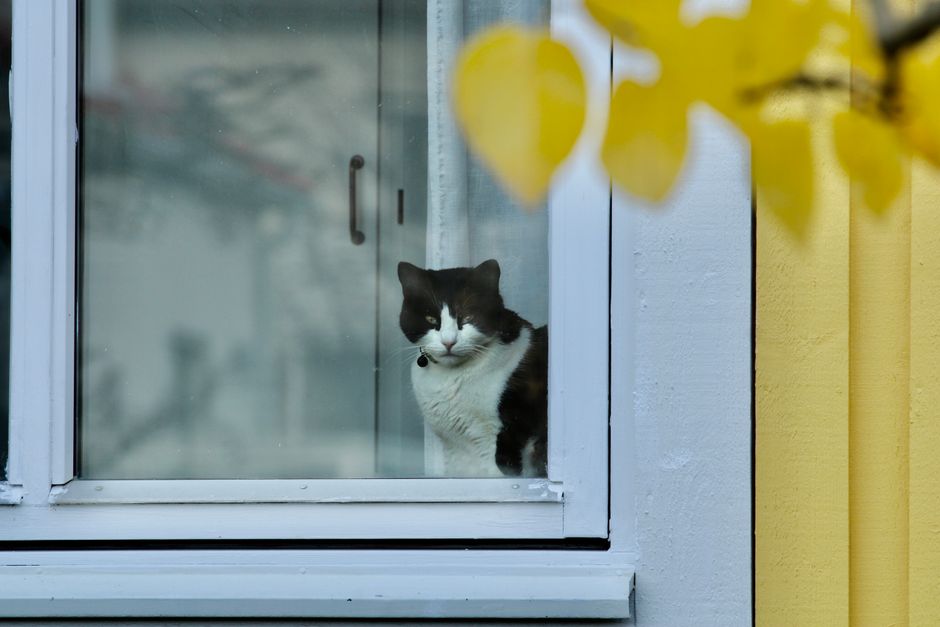
VCA says cats also mark doorways and windows. They mark new things in the home and piles of clothes, too. The sight of an outdoor cat through a window can set it off.
- Outside doors: the floor, the mat and the door frame.
- Windows: the sill and the wall below it.
- New things: a new chair, a new rug, shopping bags.
- Boxes: delivery boxes and paper bags on the floor.
Cardboard and paper are the very things the Extension expert says pee crystals cling to.
Under, Behind and Inside
Look at the carpet under beds and couches, and behind sofas. Check closet floors and plant pots, too. If the smell is in the couch itself, our guide to getting cat pee smell out of a couch covers the cushions and the cleaning code.
Use a Black Light the Right Way
A black light helps, but only in real darkness. A UV flashlight makes dried cat pee glow. Catster, in a vet fact-checked article, says a cat pee stain glows bright yellow. Sometimes it has a green tint.
-
1
Wait until dark
Close the curtains and turn off every light. Catster says a dark room is key.
Why: a faint glow is easy to miss in a lit room.
-
2
Go low and slow
Hold the light near the floor. Sweep it slowly, a small patch at a time.
-
3
Check upright things
Sweep the lower walls, door frames and the sides of furniture.
Why: spray marks land on upright surfaces.
-
4
Tape the edge
Catster suggests marking each stain with tape or string. Painter's tape comes off clean. Put it around the edge of the glow.
-
5
Sniff to confirm
Turn the lights on. Put your nose close to each taped spot.
Why: other things glow, too.
Not everything that glows is pee. Preventive Vet notes that laundry detergent can glow under UV light. So can milk, honey, cooking oil, ketchup and tonic water. Molds can glow, too, and so can some body fluids besides pee. So a glow is a lead, not proof. Your nose makes the final call.
Rule Out Other Smells
Sometimes the smell isn't cat pee at all. Nothing glows and nothing smells up close? Look for a smell that's easy to mistake for it. Rover lists mold, mildew, ammonia-based cleaners and rotting food.
💧 Damp spots
Under sinks, behind the washer, and in closets on outside walls. Mold and mildew can hide there.
🧴 Cleaners
An ammonia cleaner can smell a lot like pee. Cornell says cleaners with ammonia or vinegar smell like urine.
🗑️ Food
Rotting food is easy to miss. Check the trash, the fridge and any grocery bags left on the floor.
🌿 Shrubs by the door
An Extension master gardener on Ask Extension says boxwood has a natural scent that smells like cat urine.
Also scoop and wash the litter box, then see if the smell fades.
Clean Every Spot You Find
Clean each taped spot as deep as the pee went. A quick spray only reaches the top. Tempted to reach for vinegar? Our vinegar vs. enzyme cleaner comparison explains why it often falls short.
-
1
Blot
If a spot is still damp, press paper towels into it. Don't rub.
-
2
Soak
Wet the taped area and a bit past the tape. The Feline VMA says to clean a big enough area to remove the smell. That may be up to three times the size of the stain.
Why: the cleaner only works where it reaches.
-
3
Wait 10 to 15 minutes
Or as long as the label says. Leave it alone.
-
4
Blot again
Press a dry towel in hard.
-
5
Air-dry
Skip the heat. Humane World warns that a steam cleaner's heat can set the stain and the smell for good.
-
6
Sniff and repeat
Once it's fully dry, sniff up close. Old spots often need a second round.
LitterBond's Urine Odor Eliminator is made for the soak step. It's a bio-enzyme spray with persimmon tannin and plant extracts. It breaks down cat pee odor at the source instead of masking it. It comes in a 400 ml trigger bottle and a 100 ml mist bottle. Here is its honest limit. It only works where it reaches, so a light spritz won't do. Old or set-in spots often need more than one round.

It has a light, fresh scent. Spot-test a hidden patch first. Open a window, and keep your cat out of the room until the spot is dry. Cats are sensitive to essential oils and strong scents. Never spray it on your cat. Never use it with bleach or ammonia cleaners.
Check the Pad and the Baseboards
Pee on carpet can soak down into the pad below. Lift a corner near the taped spot and sniff the pad. Once pee soaks into the padding, Humane World says you may need to replace some carpet and padding. CatWatch adds that a spot used for a long time may mean a new pad or new baseboards. Spraying the surface can't reach that deep. If the smell comes from the floor under the pad, call a flooring pro.
Some things can't be saved. International Cat Care says to throw out heavily soiled fabrics or furniture where you can. The Extension expert gives the same advice for boxes, books and papers that still smell after an enzyme cleaner.
When the odor eliminator fits, and when it doesn't:
✅ Good fit
Carpets, rugs, cat beds, bedding and the floor around the litter box. Also cloth couches with a W or W/S cleaning code.
🧱 Pad or floor soaked through
Spraying the surface can't reach it.
🛋️ Leather, S or X code
Water-based cleaners are not meant for these.
🩺 Peeing for a health reason
No cleaner fixes the reason she went there.
Never use bleach or ammonia on cat pee, and never mix cleaners. The ASPCA explains that urine contains ammonia. So an ammonia cleaner could draw your cat back to the same spot. More tools for litter box smells are in our odor and home cleaning collection.
Call Your Vet About New Spots
A new pee spot is a question for your vet before it's a cleaning job. The Feline VMA says every cat that starts to pee around the house needs a full exam and a urine test. Health problems such as cystitis, arthritis, kidney problems and diabetes can be behind it.
Call your vet soon if your cat:
🩺 Call your vet if your cat:
- Cries or seems uncomfortable in the litter box
- Goes more often than usual
- Has blood in her pee
- Pees outside the box
A cat who tries to pee and can't, or passes only a little, must be seen urgently. International Cat Care is clear on that. The Cornell Feline Health Center calls a blocked urethra "a true medical emergency." Male cats are at greater risk, because their urethra is longer and narrower. Don't wait until morning.
Once your vet rules out a health problem, a thorough cleanup matters. Cornell notes that cats will re-soil and spray areas they have marked with their scent. International Cat Care says a cat's sensitive nose pulls it back to the same place. Cornell also suggests one litter box per cat, plus one. Is she spraying near a window? VCA suggests limiting her view of outdoor cats. If the habit keeps up, talk to your vet.
Never punish her. International Cat Care says punishment only makes a cat fearful and the problem worse.
If you do one thing tonight, make it this. Wait until dark, turn off the lights and sweep a black light low across the room that smells. Tape every glow, then sniff it with the lights on. Soak each real spot as deep as it went, and let it dry fully before you judge. You might use the Urine Odor Eliminator or another enzyme cleaner. Either way, finding every spot matters more than the bottle.

For every spot you taped
Soak it deep, then give it time
A bio-enzyme spray with persimmon tannin and plant extracts that breaks down cat pee odor at the source. Soak each spot you marked, wait 10 to 15 minutes, blot and let it dry. Repeat on old spots. Free US shipping on orders $39+ · 30-day returns
See the Urine Odor Eliminator →Questions this guide did not cover
Can I find out which cat is peeing?
Your vet can help with that. VCA Animal Hospitals describes one way: a fluorescent dye is given to one cat, and the soiled areas are then checked with a black light to see if that cat is the one.
Will an air freshener cover the smell?
Not for your cat. The Cornell Feline Health Center says odors must be neutralized, not just deodorized, to escape a cat's keen sense of smell. Cats are sensitive to essential oils and strong scents, so skip heavily scented sprays and air fresheners.
How long can old cat pee keep smelling?
For years, if nothing breaks it down. An expert on Ask Extension says the odor can persist for years. For small things you can carry outside, the same expert suggests an enzyme product made for urine odor, then direct sunlight and good airflow.
What if my cat goes back to a spot I cleaned?
It happens, especially with spraying. VCA Animal Hospitals notes that a cat may refresh a cleaned spot with more urine. It suggests putting a food dish or a cozy bed there, or a scratching post nearby. If it keeps happening, talk to your vet.
Related reading
- How to Get Cat Pee Smell Out of a Couch (Even When It Keeps Coming Back)
- Vinegar vs. Enzyme Cleaner for Cat Urine: Which Actually Removes the Smell?
About this article
Researched and written by the LitterBond Team. Sources include the Feline Veterinary Medical Association (FelineVMA, formerly AAFP), VCA Animal Hospitals, the ASPCA, the Cornell Feline Health Center and International Cat Care. Reviewed and updated October 30, 2026. LitterBond does not employ veterinarians; for medical decisions about your individual cat, always consult your veterinarian.


