
How to Make Your Cat Smell Good (Without Perfume)
LitterBond Team
By the LitterBond Team · Researched against Cornell Feline Health Center, VCA and iCatCare guidance · Last updated: November 20, 2026
Your guests arrive on Thursday. Tonight you scoop up your cat for a cuddle, and something smells off. Maybe it's her breath. Maybe it's her fur, or the blanket she sleeps on. Your first thought is a quick spritz of something nice.
Hold off on that. The way to make your cat smell good is to find the smell and fix it at the source. A healthy cat does most of the work herself. As a vet explains on PetMD, "Regular self-grooming is one of the reasons that cats tend to have little odor."
So a smell is a clue, not a flaw. It usually comes from her teeth, her ears, her rear end, her coat, or the places she sleeps. Below: how to track it down, a short routine that helps at home, and what never to put on a cat. You'll also find the signs that mean a vet visit.
Find Where the Smell Comes From
Sniff before you clean, because the fix depends on the source. Get close while she is relaxed. Check one spot at a time. Most smells come from one of six places.
Check Her Breath
Her mouth is the most likely spot. PetMD says dental disease is the most common cause of unpleasant cat odors.
Some breath smells point somewhere else. The Cornell Feline Health Center says a sweet, fruity smell might mean diabetes. A smell like urine or ammonia could mean kidney disease. Cornell's advice is plain: bad breath that doesn't go away should be checked by a vet.
Once your vet has looked, daily care at home can help keep her breath fresher. See how to clean your cat's teeth without brushing for options that ask very little of her.
Check Her Ears
Look inside the ear flap, but don't dig. VCA Animal Hospitals says ears with a problem often turn red and may develop a bad odor. A black, brown or yellow discharge is common. Many cats shake their head and scratch at the ear.
VCA also says your vet must find the exact cause before choosing what to use. So a smelly ear goes to the vet, not to a cotton swab.
Check Under Her Tail
A cat who can't reach her back end can start to smell. Long fur holds on to bits of litter and poop. Heavy cats have a harder time, too. There is more on this below.
Check Her Coat and Skin
Part the fur on her back and take a sniff. A greasy, clumpy or stale coat often means she isn't grooming well.
The Cornell Feline Health Center says older cats groom themselves less well than young cats. That can lead to matted hair and skin odor. PetMD adds that cats who are sick, stiff from arthritis or overweight can't groom well either.
Check for a Wound
A strong, rotten smell from one spot can mean a wound. Cats who go outdoors or live with other cats can get bite wounds.
International Cat Care (iCatCare) says an abscess can take two to three days to form after a bite. If it bursts, you will see pus and may notice a bad smell. Call your vet if you find a swelling or a sore spot.
Check Her Bed and Litter Box
Sometimes the cat is fine, and her things smell. Litter dust clings to paws and fur. Blankets and cat beds soak up body oils and hair over time. If her fur smells fresh but the room doesn't, start with the home.
Brush Her Coat Every Week
Brushing is the simplest way to keep her coat fresh. Her tongue does most of the cleaning. iCatCare explains that its backward-facing spines remove loose hair and dirt. A brush finishes the job where she can't reach.
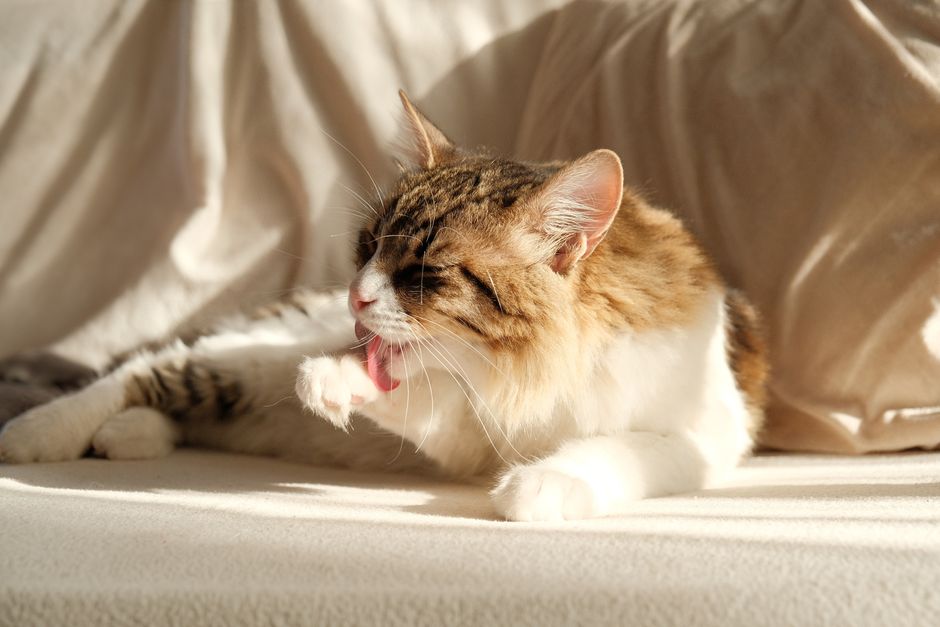
iCatCare suggests grooming a short-haired cat at least once a week. Groom a long-haired cat every day, for as long as she is comfortable.
Brush from head to tail, the way the fur grows. Spend a little extra time on her lower back and the backs of her thighs. Those are the spots heavy and senior cats miss. Keep each session short, and end with a favorite snack.
Give Her a Quick Wipe-Down
A wipe-down lifts the everyday dust and dirt a brush leaves behind. It is not a bath, and it asks much less of her. Do it after brushing, when she is calm.
-
1
Warm the cloth or wipe in your hands
Hold it between your palms for a few seconds.
Why: a cold, wet touch is a shock.
-
2
Let her sniff it first
Hold it near her nose and wait for her to look away.
-
3
Stroke from head to tail, with the fur
Slow, light strokes. Skip her eyes and the inside of her ears.
-
4
Finish on the spots she can't reach
Her lower back and the base of her tail.
-
5
Let her coat air-dry
Then hand over a favorite snack, so she leaves with a good memory.
A soft cloth dampened with warm water works. So does a glove wipe made for cats. LitterBond's waterless bath glove wipes slip over your hand, so the wipe-down feels more like petting than bathing. There is no water and no rinsing. The glove lifts loose fur and everyday dirt, and the label calls it deodorizing and moisturizing.
Know its limits, though. It is a quick clean-up, not a perfume. It handles light dirt and odor, not heavy soiling. A long-haired or very dirty cat may need a second glove. And no wipe can fix a smell that starts in her mouth, her ears or her skin.
Give her face its own soft pass. Food and drool can collect on her chin and in the corners of her mouth. Use a fresh cotton pad dampened with warm water. Or use LitterBond's tear stain wipes, soft pre-moistened pads that also work on the chin and around the mouth, with no rinse. If your cat is sensitive to smells, try one pad on her chin first. Never wipe the eye itself.
If you notice redness, discharge, swelling, squinting or persistent scratching, stop and see your vet.
For the full routine with no water at all, see how to clean a cat without a bath.

Grooming
A quick wipe-down between brushings
Five disposable glove wipes, each sealed in its own sachet, with a no-rinse formula. Slip one on and stroke her head to tail, the way you already pet her. For light dirt and everyday odor. It can't fix a smell that starts in her mouth, ears or skin.
See the bath glove wipes →Help With the Parts She Can't Reach
Some cats need help with their rear end, and that is nobody's fault. Long fur traps bits of litter and poop. Extra weight and stiff joints make the area hard to reach.
A Texas A&M vet notes that an overweight cat may have a hard time grooming near her rear end. Some of these cats need a "hygienic" shave there. It keeps urine and poop from building up, which could hurt her skin.
For a small mess, hold a warm, damp cloth on the spot for a minute. That softens it. Then wipe gently, the way the fur grows, and pat it dry. Don't tug. A glove wipe on her hips and the base of her tail helps between trims.
For a long-haired cat, ask a groomer or your vet about a sanitary trim. It is a short clip of the fur under the tail. If she keeps getting dirty back there, talk to your vet. Your vet can check whether her weight or stiff joints are part of it.
Freshen Her Bedding and Litter Box
If her coat smells fine, the smell is probably in her things. A holiday reset takes one afternoon.
Start with the litter box. The Cornell Feline Health Center gives simple steps:
- Scoop every day. Remove clumps and poop, then add clean litter.
- Change the litter often. It should look and smell dry and clean.
- Scrub the box. Use a gentle detergent, dry it, then refill it.
- Count the boxes. Keep one per cat, plus one.
Cornell also notes that most cats prefer unscented litter. So skip the perfumed kinds, even with guests coming.
Then wash her bedding. Put her bed cover, her blankets and the throw on her couch spot in the wash. Once a week is a good habit through the holidays. Use a mild detergent with no added scent.
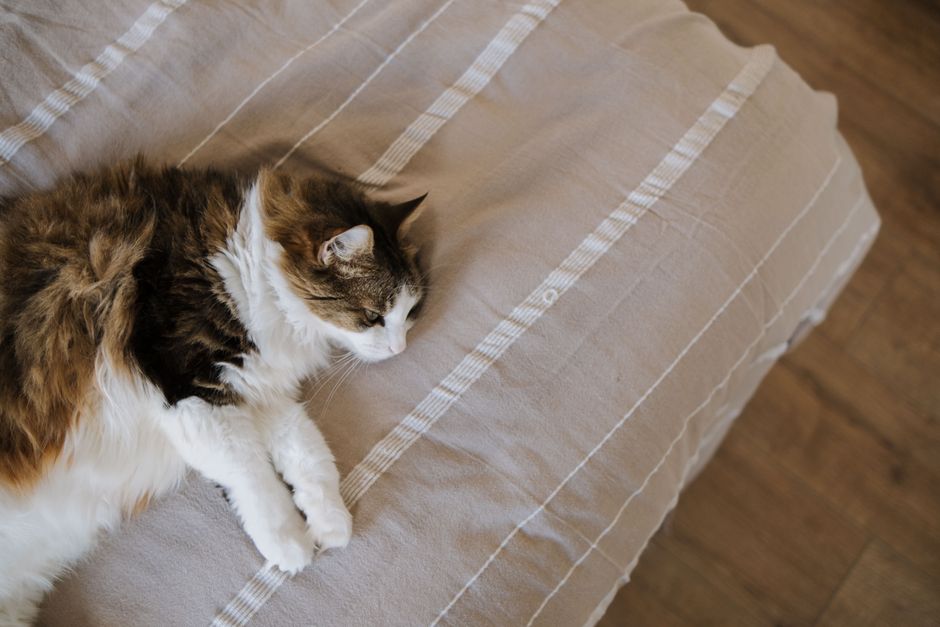
Is the smell pee in a couch cushion? See how to get cat pee smell out of a couch. A cat who suddenly pees outside the box needs a vet check first.
Skip the Perfume and Scented Sprays
Cats don't need perfume, and strong scents are hard on them. Cats are sensitive to essential oils and strong scents. There are three reasons.
Her nose is far stronger than yours. The ASPCA puts it this way: "something that seems light to us may be overwhelming to them." A spritz that smells nice to you can be far too much for her.
Her body handles oils differently. Pet Poison Helpline explains that cats lack an enzyme in the liver that helps clear essential oils. Its vet writes that concentrated essential oils should never be put directly on cats.
And she will lick it off. iCatCare notes that cats groom any substance off their coats and swallow it. Whatever goes on her fur ends up in her mouth.
❌ Keep off her coat
Perfume, cologne or body spray. Essential oils, even a drop. Scented sprays or powders. Baby wipes and other human wipes. Your own shampoo or soap.
✅ Use instead
A brush, a damp cloth, a wipe made for cats, and clean bedding. They clean away the smell instead of covering it.
Call Your Vet About a New Smell
A smell that is new, strong or keeps coming back is a reason to call your vet. PetMD's rule of thumb is simple. Unless you can easily find a harmless source, make an appointment.
Watch for these signs:
⚠️ Call your vet if you notice any of these
- Breath that smells sweet, fruity or like ammonia
- Bad breath that doesn't go away
- Red or bleeding gums, drooling or dropping food
- A smelly ear, dark discharge, head shaking or scratching
- A swelling or sore that smells bad
- A fishy or rotten smell from under the tail that won't go away
- A greasy, matted coat, or a cat who quits grooming (it can be a sign of pain)
If you notice redness, discharge, swelling, squinting or persistent scratching, stop and see your vet.
One exam can cover her teeth, ears and skin at once. That is often the fastest way to a fresher cat.
If you do only one thing before your guests arrive, wash her bedding and give her a gentle brush. Then sniff again. If the smell is gone, it was her things. If it is still there, it is a clue worth taking to your vet. Either way, she can greet your guests smelling like herself. And if she'd rather hide when the doorbell rings, see why your cat hides when guests come over.
Questions this guide did not cover
Should I give my cat a bath before guests come?
Usually not. International Cat Care says there is no reason to bath a healthy cat, and most don't tolerate it well. A Texas A&M vet agrees that most cats do not usually need a bath for a healthy skin and coat.
Why does my cat smell like fish?
Often it comes from her anal glands. PetMD explains that cats have two small glands near the anus that make a musky or fishy material. If the smell lingers, ask your vet to take a look.
Is an essential oil diffuser OK in a home with cats?
Keep it out of her space. Pet Poison Helpline warns that droplets from a running diffuser can collect on a cat's fur, then get swallowed when she grooms. The ASPCA says a short run in a closed room your cat can't enter is not likely to be an issue.
What if my cat gets something oily or smelly on her fur?
Stop her from licking it and call your vet. iCatCare says to stop her grooming and contact your vet team right away. They'll tell you whether and how to wash it off. You can also call the ASPCA Animal Poison Control Center at (888) 426-4435.
Related reading
- How to Clean a Cat Without a Bath: A Calm, Waterless Routine
- How to Clean Your Cat's Teeth Without Brushing: 7 Options, Ranked
About this article
Researched and written by the LitterBond Team. Sources include the Cornell Feline Health Center, VCA Animal Hospitals, International Cat Care, the ASPCA and PetMD. Reviewed and updated November 20, 2026. LitterBond does not employ veterinarians; for medical decisions about your individual cat, always consult your veterinarian.


