
Best Cat Water Fountain: Stainless Steel, Ceramic or Plastic?
LitterBond Team
By the LitterBond Team · Researched against Cornell Feline Health Center, iCatCare and VCA guidance · Last updated: October 18, 2026
The best cat water fountain is the one your cat will use and you will clean. Steel, ceramic and plastic all work for some cats. A fountain is also optional. A clean bowl of fresh water does the basic job.
You stand in the pet aisle with six fountains in a row. Each box makes a promise. This guide gives you a short set of checks instead. It compares the three materials, audits what a fountain is made of, and weighs two fountains from our shop, including what each cannot do.
Start With the Cat
Some cats like moving water, and some do not. Cornell Feline Health Center says some cats drink more when they have a fountain, but cats differ in what they prefer. International Cat Care agrees that some cats like moving water. It adds that fountains should be introduced gradually.
So a fountain is a test, not a fix. Cornell also says fresh water should always be easy to reach. It notes that wet food adds water to your cat's day, so how much she drinks depends partly on her diet. Fresh water should also be easy to reach in more than one spot.
Ask yourself three things before you buy. Does your cat already drink from the sink? Do you have a free outlet near her water spot? Will you wash the parts every week? If the last two answers are no, a bowl may suit you better.
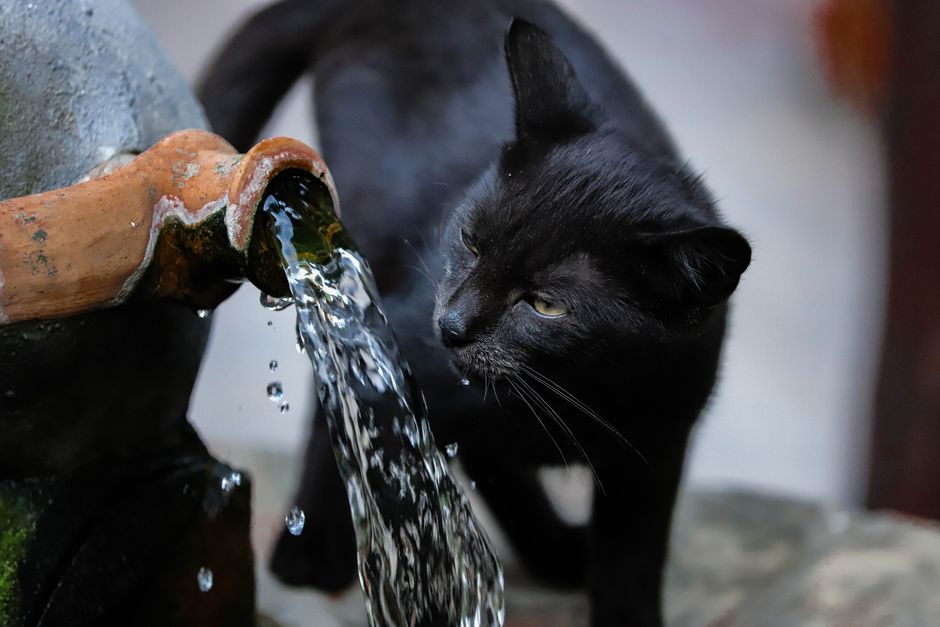
Keep a plain, clean bowl out, even if you buy a fountain. If she ignores the new fountain, she still has her usual water. A second Cornell page agrees that a running water source may encourage some cats to drink more. It adds that fresh water must stay available at all times.
Compare the Three Materials
Most vet guidance is about bowls, not whole fountains. That matters. A fountain has a bowl, a tray, a pump and a reservoir, and each may be a different material. The advice below tells you what your cat's mouth and whiskers may prefer. It cannot rank complete fountains.
| Material | What the vet guidance says | What to watch |
|---|---|---|
| Stainless steel | VCA Animal Hospitals lists metal among bowls to try | Check which part is steel. The whole unit may not be |
| Ceramic | International Cat Care says cats generally prefer glass and ceramic to plastic | Check the whole unit, not just the dish |
| Plastic | Both sources say cats generally prefer other materials | Plastic can still work if your cat accepts it. Check that you can clean every part |
Stainless steel. VCA says to try glass, metal or ceramic bowls instead of assuming one suits every cat. For a fountain, ask what touches the water. The bowl may be steel while the tray, window or pump is not.
Ceramic. International Cat Care says cats generally prefer glass and ceramic bowls to plastic ones. That is bowl advice. LitterBond does not sell a ceramic fountain, so this guide does not recommend one. If you pick ceramic, check the whole unit, not just the dish.
Plastic. Both sources lean toward other materials. A plastic fountain can still suit a cat who drinks from it. Make sure you can reach every part with a brush. Hard-to-reach spaces are a cleaning question more than a material question.
If you are unsure, test the material first. VCA's advice is to experiment. Set out two plain bowls in different materials, side by side. Watch which one she visits. That tells you more than any label. Then pick a fountain whose water parts match her choice.
A wide, shallow dish is another cat-led choice. International Cat Care says many cats prefer one. If your fountain has a narrow tray, watch whether your cat seems to dislike it.
Audit the Fountain Design
A fountain label tells you less than a spec check does. Use this table on any fountain, including ours. The first two columns show what LitterBond's product pages say.
| Check | Stainless model | Milk Tea model | What to verify |
|---|---|---|---|
| Water-contact build | Polished 304 stainless bowl. The clear tray and window material is not listed | ABS plastic body with a tray and a straw spout | Which parts touch water and your cat's tongue |
| Capacity and level | Up to 2.5 L, with a MIN and MAX window | Up to 1.8 L, with a side level window | Household size and how often you refill |
| Flow | A faucet spout, or a bubbling tray with the spout off. A Motion Sensor style starts when your cat comes near | A curved straw pours a stream into the tray | Does your cat like a stream, a pool or a still bowl |
| Noise | No maker rating listed | The maker rates the pump around 40 dB. Pouring water is still audible | Do not trust "quiet" with no stated method |
| Filter | Foam sponge plus a cartridge. The maker suggests changing both about monthly | A three-layer cartridge. No fixed change interval | Where you will buy refills, and the cost |
| Power and care | 5 V USB with a cable and a US adapter. Unplug before cleaning | 5 V USB pump. The wall adapter is not included. Unplug before cleaning | Where the cord runs, and where you will wash the parts |
Here is how to use the table. Copy the six rows onto a note, and fill them in for each fountain you consider. If a row stays blank, ask the seller before you buy. A blank row is a fact too.
A filter layer list is not proof of anything. A list of what is inside a cartridge does not tell you what it takes out of the water. Neither product page says the filter cleans the water or removes germs, and we will not say it either. Treat the filter as a part you must maintain, and check that replacements are available before you buy.
Also check the words around noise. "Quiet" means little without a method. The only figure here is the maker's own rating for the Milk Tea pump. The stainless page lists none.
Match Capacity, Noise and Upkeep
Capacity means fewer refills. It does not mean your cat drinks more. A one-cat home may not need the biggest tank. A home with several cats may refill a small one often. A bigger reservoir is a convenience, nothing more.

Noise is model-specific. Only trust a number when the maker states it and says how it was measured. For the Milk Tea pump, the maker's rating is around 40 dB, and the main sound is pouring water. For the stainless model, no rating is listed. A cat who startles at sounds may need a trial run before the pump is on.
Upkeep decides whether a fountain works for you. Count the parts before you buy. Ask how the pump comes out. Ask where you will get filters. VCA says to wash and rinse bowls daily, and to clean a fountain's filter weekly or as the maker directs. A second VCA page says to learn how to clean the fountain and to think about cord safety.
Plan for a full clean about once a week for both LitterBond fountains. Dishwasher use is not confirmed for either. Buy replacement filters before the first one is due, if you can. Daily bowl washing helps cats that are picky about cleanliness, says the same VCA page. Ask yourself if you will do this every week. If not, a bowl is fine.
Weigh the Two Fountains Side by Side
Each fountain has a bounded job. The Stainless Steel Water Fountain 2.5 L has a polished 304 stainless bowl and a clear tray on top. It comes in two styles. Standard flows whenever it is plugged in and has a curved spout for a tap-like stream. Take the spout off, and water bubbles up across the tray. The Motion Sensor style starts the water when your cat comes near. Many cats would rather drink from a running tap than a still bowl, but not all.
Here are its limits. The tray and window are clear, but their material is not listed. Pump power and noise are not listed. A low-water auto shut-off is not listed either, so check the window daily and never let it run dry. Spare filters are not sold on the product page.

The Milk Tea Cup Water Fountain 1.8 L is an ABS plastic fountain shaped like a boba cup. It pours a steady stream from a curved straw. It has a low-power USB pump that cuts out when the water runs low. The side window shows the level. The base, lid and filter come apart for cleaning.
Its limits are plain too. It needs a USB power source, and the wall adapter is not in the box. It is unclear whether the plain colors come with a filter. The versions marked "+ 3 Filters" add three cartridges. No change interval is given.
Neither page claims a health benefit, and neither should you. Choose the stainless one if you prefer a steel bowl and a choice of flow. Choose the Milk Tea one if you like its cup shape and have a USB power source to use. Or choose neither, and keep the bowl.
Introduce It and Keep It Clean
-
1
Set it down, dry
Put it in the spot you chose. No water, motor off.
-
2
Add water
Do this once she is comfortable near it.
-
3
Turn the motor on
Do this last, once the water is in.
International Cat Care also says to give each cat one water bowl plus one extra, and to place them away from food in quiet, easy-to-reach spots. VCA says to keep water away from the litter box.
If she walks past it for a week, do not push. Move it closer to her usual spot. Try the other flow, such as the bubbling tray. Or go back to the bowl for now. A fountain is never a test she can fail.
Then run a routine:
✅ Weekly fountain clean
- Unplug the fountain first
- Wash the removable bowl, tray, lid and filter parts by hand
- Clean the pump exactly as the product instructions direct
- Do a full clean about once a week
- Change the filter when the maker says to, or sooner if it looks stained or the flow slows
Know When a Fountain Is Not the Answer
A fountain cannot diagnose or treat a health problem. Cornell says to contact your vet promptly if you think your cat is dehydrated. The same VCA page says excessive drinking, excessive urination, vomiting or diarrhea need veterinary attention.
A second Cornell page lists signs that need quick contact with a vet in hot weather, including weakness, collapse, heavy panting, drooling, vomiting or diarrhea. Do not wait to see if a fountain helps.
If your cat suddenly drinks much more or much less than usual, call your vet before you buy anything. Keep plain, fresh water out the whole time. A fountain is a nice extra for a cat who likes it, and the rest is up to her and her vet.

Feeding & Water
Check the listed fountain details
Review the listed bowl, flow, level window and care details. Keep a plain bowl available during a gradual introduction.
See the fountain detailsHere is the short version. Choose a fountain if your cat likes moving water and you will clean it every week. Choose a bowl if she is happy with one, or if upkeep will not fit your week. Either way, fresh water comes first.
Common questions
Are cat water fountains worth it if my cat already drinks from a bowl?
Not always. Cornell Feline Health Center notes mixed results: some cats raise their intake with a fountain and others do not. A cat who drinks well from a clean bowl can skip one. Tell your vet if her drinking changes.
Why won't my cat drink from the new fountain?
Slow down. International Cat Care advises a gradual introduction, so let her sniff the unit first and leave her usual water out. After a long stretch of no interest, accept her choice and keep the bowl.
Do cats prefer stainless steel fountains to plastic ones?
VCA Animal Hospitals says cats often prefer glass, metal or ceramic bowls, which is about preference. With any material, look at the cord, the cleaning access and the maker's directions.
How often should I clean a cat water fountain?
Follow the maker's directions first. VCA Animal Hospitals recommends washing bowls daily and cleaning fountain filters weekly. A quick daily look at the water level is a practical check.
Related reading
- How to Get Your Cat to Drink More Water: What Actually Helps
- Stainless Steel vs. Ceramic vs. Plastic Cat Bowls: Which Is Best?
- How Often Should You Wash Cat Bowls? (And What That Slime Is)
About this article
Researched and written by the LitterBond Team. Sources include the Cornell Feline Health Center, International Cat Care and VCA Animal Hospitals. Reviewed and updated October 18, 2026. LitterBond does not employ veterinarians; for medical decisions about your individual cat, always consult your veterinarian.


